medical-image-classifier
Medical Image Disease Classifier API
A production-style medical image classification service that accepts a brain scan image and returns a predicted disease class with calibrated-style confidence scores over all classes. It is inspired by an Alzheimer’s PET classification research project and re-frames that work as a deployable ML system: preprocessing, model serving, an HTTP API, containerization, tests, CI, and explainability.
Disclaimer. This project is for educational and portfolio demonstration only. The model is trained on a synthetic dataset, is not clinically validated, and must not be used for medical diagnosis or any clinical decision-making. Every prediction response repeats this disclaimer.


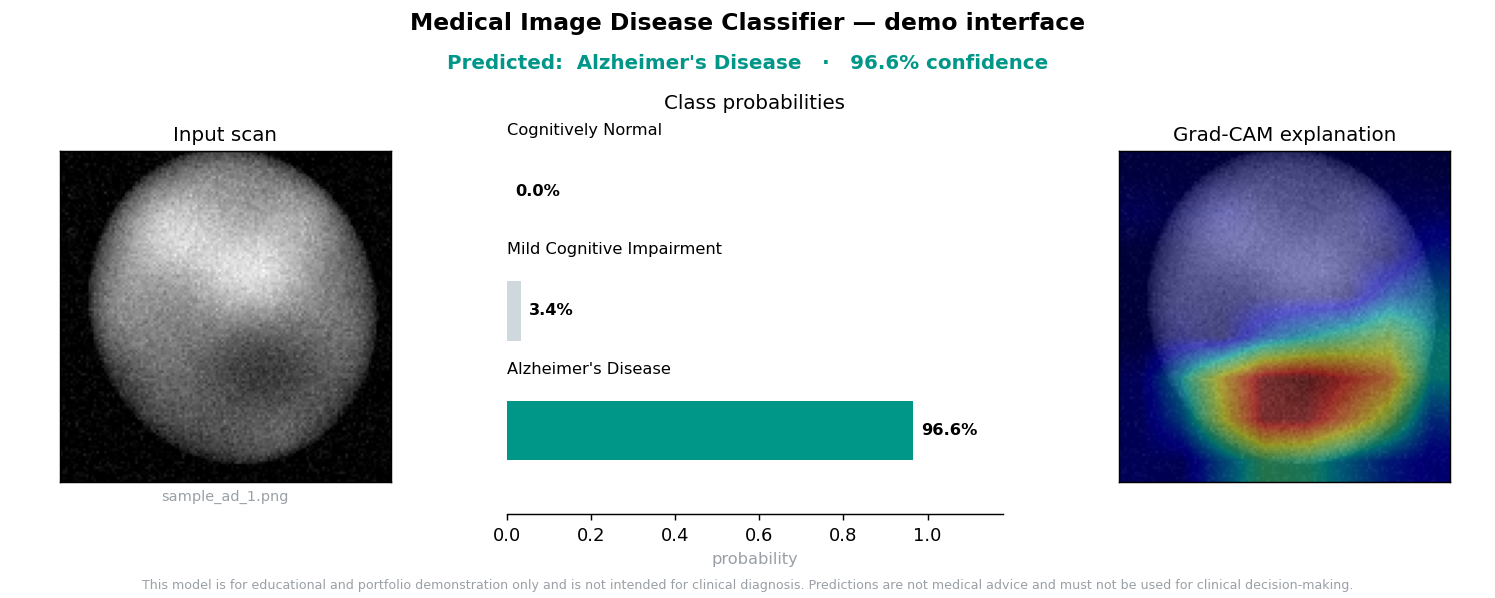
The demo takes an image and returns the predicted class, a probability breakdown, and a Grad-CAM explanation of where the model looked. Output shown is from the committed model on a bundled sample.
Table of contents
- What this project is
- Why it matters
- System architecture
- Tech stack
- Model approach
- Dataset
- Quickstart
- Demo interface
- Using the API
- Evaluation results
- Explainability (Grad-CAM)
- Project structure
- Testing & CI
- Limitations
- Future work
- What this project demonstrates
What this project is
The original research project trained transfer-learning models (VGG16, InceptionV3, ResNet50) to classify amyloid-PET brain scans from the access-restricted ADNI dataset into cognitive-status categories. That work stopped at the notebook stage.
This project extends that workflow into a production-style ML service. Instead of stopping at model training, it focuses on the full deployment path:
Raw image → validation → preprocessing → model inference → structured response
          → API / demo UI / CLI → Docker → tests → documentation
The three classes are:
| Class | Meaning |
|---|---|
Cognitively Normal |
No cognitive impairment |
Mild Cognitive Impairment |
Intermediate stage |
Alzheimer's Disease |
Alzheimer’s-stage impairment |
Why it matters
Many ML portfolios stop at a .ipynb with a high accuracy number. Hiring teams
for ML/AI engineering roles look for the next step: can you turn a model into a
service someone else can run? This repository is built to answer that question.
It demonstrates model serialization, an inference API with input validation and
error handling, reproducible training, a Dockerized runtime, automated tests, CI,
and honest evaluation — the things that separate an ML engineering project from
an ML notebook.
System architecture
        TRAINING (offline)                       INFERENCE (online)
 ┌──────────────┐  ┌────────────┐        ┌───────────┐  ┌───────────────┐
 │ dataset      │─▶│ preprocess │─▶ ... ─▶│ model.pt  │─▶│ FastAPI /      │
 │ (synthetic   │  │ transforms │        │ weights + │  │ Streamlit /CLI │
 │  or real)    │  └────────────┘        │ metadata  │  │  → JSON + PNG  │
 └──────────────┘        ▲               └───────────┘  └───────────────┘
                         │                     ▲
                         └───── same preprocessing path ─────┘
The same preprocessing function is used at train and serve time, and the
normalization statistics are stored inside the checkpoint, eliminating
training/serving skew. See docs/architecture.md for
details.
Tech stack
- ML: PyTorch (CPU), NumPy, scikit-learn (metrics), Matplotlib (plots)
- Serving: FastAPI + Uvicorn, Pydantic (typed request/response schemas)
- Demo UI: Streamlit
- Packaging/DevOps: Docker, docker-compose, GitHub Actions CI, Ruff, Pytest
- Config: YAML + environment-variable overrides
Model approach
The model is a compact custom CNN (SmallCNN, ~98k parameters): four
Conv → BatchNorm → ReLU → MaxPool blocks, global average pooling, and a
dropout + linear classifier head.
Why not VGG16/ResNet50 transfer learning here? The original research used ImageNet-pretrained backbones, which are the right choice for a GPU research setting with real data. For a deployable demo service the priorities differ:
- Small artifact — the checkpoint is ~0.4 MB, so it ships in the repo and the API works immediately on clone with no weight download.
- CPU-friendly — inference is milliseconds on CPU; the container needs no GPU.
- Self-contained — no
torchvision/ImageNet download at build time, keeping the Docker image lean and the build reproducible offline.
The architecture factory (build_model) leaves a clean seam for adding
transfer-learning backbones later without touching the training or serving code.
Dataset
The real ADNI PET data is access-restricted and cannot be redistributed, so this repository ships a deterministic synthetic dataset generator. It produces grayscale brain-phantom images whose classes differ by an anterior–posterior “uptake” contrast plus per-image noise, giving a genuine but non-trivial learning signal.
This is stated plainly: the images are procedurally generated shapes, not real scans, and the reported metrics demonstrate the engineering pipeline, not clinical validity. The data is regenerated from a fixed seed, so results are fully reproducible.
Bring your own data. The training pipeline reads a standard ImageFolder
layout. To train a real model, arrange images as below and point
paths.synthetic_dir at your directory — no code changes required:
<your_data>/
  train/{CN,MCI,AD}/*.png
  val/{CN,MCI,AD}/*.png
  test/{CN,MCI,AD}/*.png
Quickstart
Requires Python 3.10+. These commands work identically on Linux, macOS, and
Windows (PowerShell or CMD) — no PYTHONPATH or make required.
# 1. Install dependencies (CPU PyTorch) and the package itself (editable)
pip install -r requirements-dev.txt --extra-index-url https://download.pytorch.org/whl/cpu
pip install -e .

# 2. Run the API — a trained checkpoint is already committed, so this works now
uvicorn medical_classifier.api.main:app --port 8000

# 3. Open the interactive docs
#    http://localhost:8000/docs
Then, in another terminal, send an image:
curl -X POST http://localhost:8000/predict -F "file=@samples/sample_ad_1.png"
To reproduce training (regenerates the synthetic data and writes reports/):
python -m medical_classifier.training.train
Tip.
pip install -e .installsmedical_classifierinto your environment, souvicorn,pytest, andpython -m ...all find it without settingPYTHONPATH. If you skip it, prefix commands withPYTHONPATH=src(Linux/macOS) or$env:PYTHONPATH="src"(PowerShell). Themaketargets set this for you.
With Docker
docker compose up --build
# API on http://localhost:8000  (docs at /docs)
Demo interface
A lightweight Streamlit app provides a visual interface: upload an image and see the predicted class, a probability bar chart, and the Grad-CAM explanation (the panel shown at the top of this README is this app’s output). It loads the model in-process, so the API does not need to be running.
python -m streamlit run app/streamlit_app.py # opens http://localhost:8501
The static preview above can be regenerated from the committed model with:
python scripts/make_demo_preview.py
Using the API
Predict on one of the bundled sample images:
curl -X POST http://localhost:8000/predict -F "file=@samples/sample_ad_1.png"
Example response:
{
  "predicted_class": "Alzheimer's Disease",
  "confidence": 0.966,
  "class_probabilities": {
    "Cognitively Normal": 0.0005,
    "Mild Cognitive Impairment": 0.0339,
    "Alzheimer's Disease": 0.966
  },
  "input_metadata": {
    "filename": "sample_ad_1.png",
    "content_type": "image/png",
    "size_bytes": 11391
  },
  "disclaimer": "This model is for educational and portfolio demonstration only and is not intended for clinical diagnosis. Predictions are not medical advice and must not be used for clinical decision-making."
}
Endpoints: GET /health, GET /model-info, POST /predict, POST /explain.
Full reference in docs/api.md. The API validates content type
and size and returns clean error codes (400/413/415/422/503).
You can also predict from the command line without starting the server:
python scripts/predict_cli.py samples/sample_ad_1.png
Evaluation results
Metrics below are produced by the committed model on the held-out synthetic
test split (135 images, balanced across 3 classes) and are reproducible via
make train. They are written to reports/ as metrics.json,
classification_report.txt, and confusion_matrix.png.
| Class | Precision | Recall | F1 | Support |
|---|---|---|---|---|
| Cognitively Normal | 0.94 | 1.00 | 0.97 | 45 |
| Mild Cognitive Impairment | 0.95 | 0.87 | 0.91 | 45 |
| Alzheimer’s Disease | 0.93 | 0.96 | 0.95 | 45 |
| Accuracy | 0.94 | 135 | ||
| Macro avg | 0.94 | 0.94 | 0.94 | 135 |
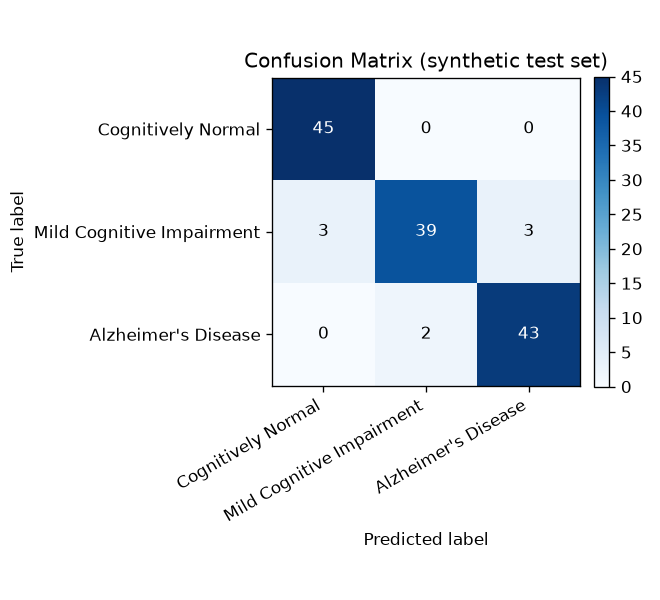
Two things worth noting, because they show the result is believable rather than inflated: the middle class (Mild Cognitive Impairment) is the hardest, and misclassifications occur only between adjacent classes (CN↔MCI, MCI↔AD) — never the extreme CN↔AD jump. That is exactly the error structure you would expect from an ordinal disease-progression task.
These numbers reflect a synthetic task and say nothing about real-world clinical performance.
Explainability (Grad-CAM)
The POST /explain endpoint (and --gradcam CLI flag) returns a Grad-CAM
heatmap over the predicted class, so a reviewer can sanity-check where the
model is looking rather than trusting a bare score.
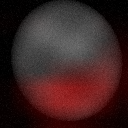
In this example the activation concentrates on the posterior region — the area that carries the discriminative signal in the synthetic data — which is a useful confirmation that the model learned the intended feature.
Project structure
medical-image-classifier-api/
├── src/medical_classifier/
│   ├── config.py            # typed config (YAML + env overrides)
│   ├── constants.py         # class taxonomy, disclaimer
│   ├── preprocessing/       # shared image→tensor pipeline
│   ├── data/                # synthetic generator + ImageFolder dataset
│   ├── models/              # SmallCNN + build_model factory
│   ├── training/            # training loop + evaluation/reports
│   ├── inference/           # checkpoint I/O, Predictor, Grad-CAM
│   ├── api/                 # FastAPI app, schemas, model singleton
│   └── utils/               # logging, seeding
├── app/streamlit_app.py     # demo UI
├── scripts/                 # data generation, sample creation, CLI predict
├── tests/                   # pytest suite (preprocessing, model, predictor, API)
├── config/config.yaml       # central configuration
├── models/model.pt          # committed trained checkpoint (~0.4 MB)
├── reports/                 # metrics.json, confusion_matrix.png, classification_report.txt
├── samples/                 # ready-to-use sample images
├── Dockerfile, docker-compose.yml
├── .github/workflows/ci.yml # lint + test + docker build
└── docs/                    # architecture.md, api.md
Testing & CI
make test    # pytest: 20 tests
make lint    # ruff
The suite covers preprocessing (shape, RGB handling, corrupt input, determinism),
the model (output shape, resolution-agnosticism, parameter budget, checkpoint
round-trip), the Predictor and Grad-CAM, and the full API (health, model-info,
valid prediction, and rejection of wrong content type / empty / corrupt uploads).
GitHub Actions runs lint + tests on Python 3.10 and 3.11 and builds the Docker
image on every push and PR.
Limitations
- Not a diagnostic tool. The model is not clinically validated and must not inform medical decisions.
- Synthetic data. The demo model is trained on procedurally generated images. Metrics demonstrate the pipeline, not clinical accuracy, and will not transfer to real scans.
- Domain shift. Real medical models degrade across scanners, sites, and populations; this project does nothing to address that.
- Confidence ≠ correctness. Softmax scores are not calibrated probabilities and can be confidently wrong.
- Small, balanced demo dataset. Real clinical datasets are larger, noisier, and imbalanced; the pipeline supports imbalance handling but the demo does not exercise it heavily.
Future work
- Train on a real, validated dataset (e.g. ADNI, with proper access) using the
same
ImageFolderinterface. - Add transfer-learning backbones (ResNet/EfficientNet) behind
build_model. - Confidence calibration (temperature scaling) and abstention thresholds.
- Experiment tracking (MLflow/W&B) and model/version registry.
- Cloud deployment, batch inference, authentication, rate limiting.
- Data-drift and model monitoring in production.
What this project demonstrates
Machine learning: image classification, CNN design, a shared preprocessing pipeline, train/val/test splits, early stopping, and honest evaluation (accuracy, precision/recall/F1, confusion matrix, per-class analysis).
ML engineering: a clean, layered project structure; model serialization with self-describing metadata; an inference API with input validation, error handling, and logging; centralized configuration; Dockerization; a test suite; and CI — with a deliberate separation between training and inference code.
Communication: a clear problem framing, documented architecture and API, reproducible results, and an explicit, prominent statement of limitations and non-clinical intent.
Inspired by an Alzheimer’s PET classification course project. Re-built as a production-style ML service. For educational and portfolio use only — not a medical device.